Find the right fit
Types of septic systems
Every property is different. Soil depth, slope and bedrock decide what will work. Scroll through each system below to see how it works, from simple gravity setups to more advanced designs.
Not sure which one you have or need? Call Steve at (417) 401-0949. He'll look at your soil and tell you straight.
System 1 · Simple
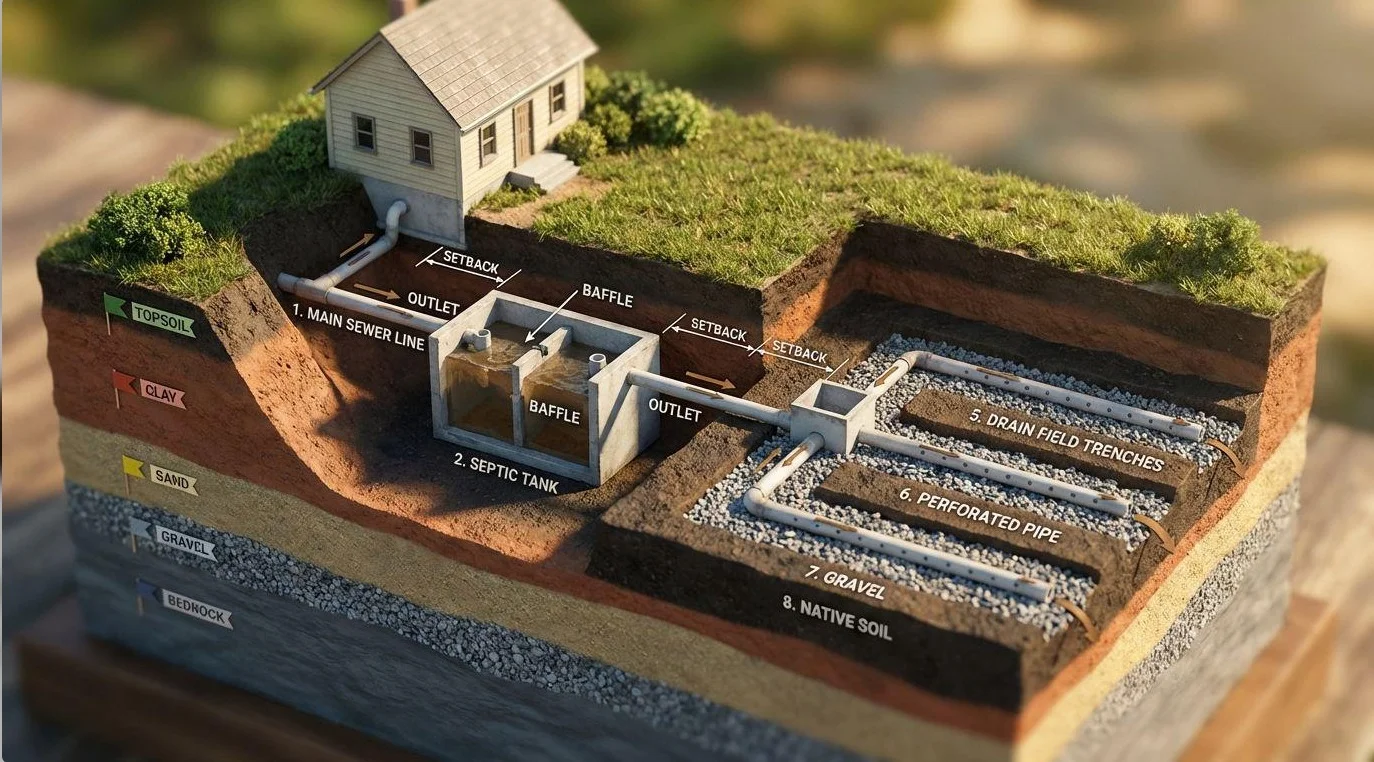
Conventional Gravity System
- 1
Main sewer line
Everything that goes down a drain in your home leaves through one main line. It needs steady downhill fall so waste keeps moving toward the tank.
⚠ Gurgling drains or slow toilets often start here.
- 2
Septic tank
The tank holds wastewater long enough for solids to sink and grease to float. Baffles keep that layer of sludge and scum inside the tank where it belongs.
⚠ Cracked tanks and missing baffles send solids downstream.
- 3
Outlet & distribution box
Clarified liquid called effluent leaves the tank and reaches a distribution box, which splits the flow evenly between the drain field lines.
⚠ A tipped or clogged box overloads one trench while others sit dry.
- 4
Drain field trenches
Perforated pipe laid in gravel-filled trenches lets effluent trickle out over a wide area so it can soak into the ground.
⚠ Soggy ground or stripes of bright green grass are warning signs.
- 5
Soil does the treatment
As effluent filters down through native soil, bacteria and the soil itself remove harmful organisms and nutrients before the water reaches groundwater.
⚠ That is why soil type and setbacks matter so much in the Ozarks.
Conventional Gravity System at a glance
Wastewater flows by gravity from the house into a septic tank, where solids settle out. Clarified effluent then flows to a distribution box and out into gravel-filled drain field trenches, where the soil finishes treating it. No pumps, no electricity, and the fewest parts to maintain.
Best for: Lots with good, deep soil that sits downhill from the house.
Why it works
- No pump, no power, fewest moving parts
- Lowest install and upkeep cost
- Long service life when maintained
What it needs
- Enough suitable soil depth below the trenches
- The drain field must sit lower than the house
- Room for the field plus setbacks
System 2 · Intermediate
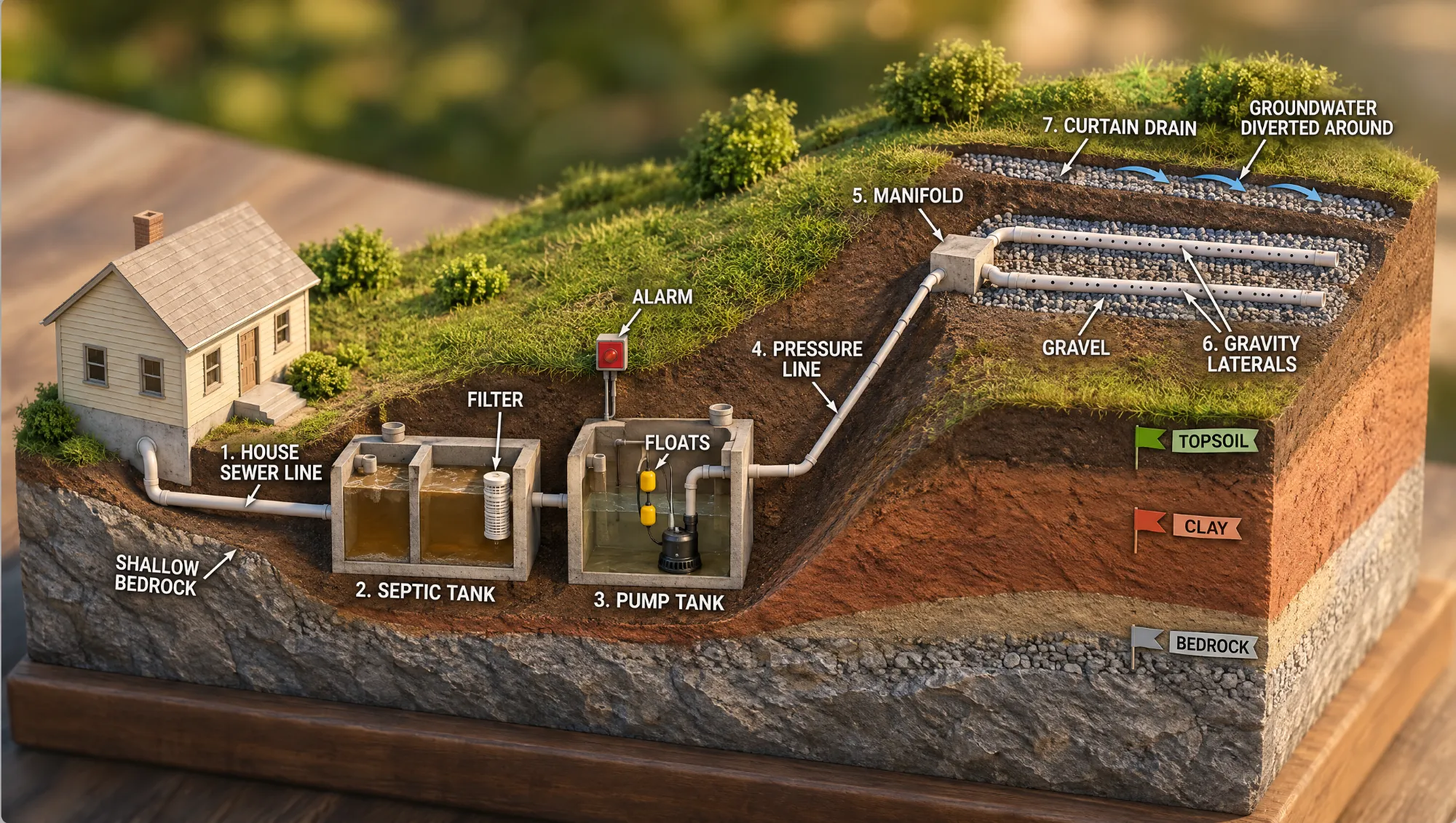
Pump-to-Gravity System
- 1
House sewer line
Wastewater leaves the home through the main sewer line. On this property the ground near the house sits on shallow bedrock, so a normal drain field right next to the home is not an option.
⚠ Shallow rock is common in the Ozarks and often rules out a standard system.
- 2
Septic tank & effluent filter
Solids settle and grease floats in a 1,000-gallon septic tank. A filter on the outlet (such as a Zabel A-100) catches small particles so only clean effluent moves on.
⚠ A clogged filter can back water up into the house. It needs periodic cleaning.
- 3
Pump tank, floats & alarm
Effluent collects in a second 1,000-gallon pump tank. When it reaches the "pump on" float, a submersible effluent pump starts. A separate high-water float sounds an alarm if anything goes wrong.
⚠ If the alarm sounds, cut back on water use and call for service.
- 4
Pressure line uphill
The pump sends effluent through a 2-inch pressure line to the best soil on the property, often more than a hundred feet away and several feet higher. It runs in a few doses a day instead of a constant trickle.
⚠ Dosing gives the soil time to rest and breathe between cycles.
- 5
Manifold & orifices
At the field, the pressure line feeds a manifold. Each lateral has a fitting with an orifice drilled to a size the county calculates, so every line gets its fair share of each dose.
⚠ Even distribution keeps one trench from wearing out early.
- 6
Gravity laterals
From the manifold, effluent flows by gravity through perforated pipe in shallow, gravel-filled trenches laid level along the contour of the hill. It trickles out and soaks into the soil, which finishes the treatment.
⚠ Trenches are kept shallow so effluent stays in the best-draining soil.
- 7
Curtain drain
A gravel-filled curtain drain dug upslope intercepts groundwater moving down the hill during wet seasons and carries it around the field, so the laterals are not flooded from above.
⚠ Roof and surface water should also be diverted away from the field.
Pump-to-Gravity System at a glance
The house drains into a septic tank fitted with an effluent filter. Filtered effluent flows into a second tank, the pump tank, where a submersible pump and float switches send it in measured doses up a small pressure line to the best soil on the property. There, a manifold with sized orifices splits each dose evenly into gravity laterals laid shallow along the contour, and a curtain drain upslope keeps groundwater out of the field.
Best for: Properties with shallow bedrock, poor soil or a slope near the house, but better soil farther away or uphill.
Why it works
- Puts the drain field where the soil is actually good
- Dosing rests the soil between cycles
- Even split between lines through sized orifices
- High-water alarm warns before a backup
What it needs
- Electrical service and a dedicated circuit for the pump
- Pump, floats and alarm checked regularly
- Effluent filter cleaned periodically
- Engineered design and county approval
Which system does your property need?
The system is chosen by the ground, not by preference. Before anything is designed, a soil evaluation looks at texture, depth to clay or bedrock, drainage and slope. That report decides what the county will approve. Simple sites get a conventional gravity system. Tougher sites need help from pumps, pressure distribution or advanced treatment.
Steve handles the whole process: coordinating the soil evaluation and any engineered design, permits, installation and the walkthrough when it's done. Already have a system? Our septic inspection tells you what you've got and what shape it's in.
Talk to Steve · (417) 401-0949Septic system type questions
How do I know which type of septic system my property needs?
It comes down to your soil, slope, depth to bedrock or water, lot size and household size. In Missouri a soil evaluation is done first, and the results decide which systems the county will approve. Steve walks you through the options that fit your site.
Why would a property need a pump-to-gravity system?
When the soil near the house is too shallow, too wet or sits on bedrock, but there is better soil farther away or uphill. A pump moves the effluent to that good soil, where it drains by gravity through normal laterals.
Does a pump system cost more to maintain than a conventional system?
A little. The pump, floats, alarm and effluent filter need periodic checks, and the pump uses some electricity. In exchange, you can put the drain field where the soil can actually handle it.
What does a septic alarm mean on a pump system?
It means the water in the pump tank is higher than it should be, usually because the pump, a float or the power has failed. Cut back on water use and call for service.
Thank you for your service
Military & veteran discount
Active duty, veterans and retired military: you've done your part. Let us take care of yours. Mention your service when you call and ask Steve what he can do for you.
Septic trouble? Get a straight answer.
Call or text Steve, or send a quick request and he will get back to you.